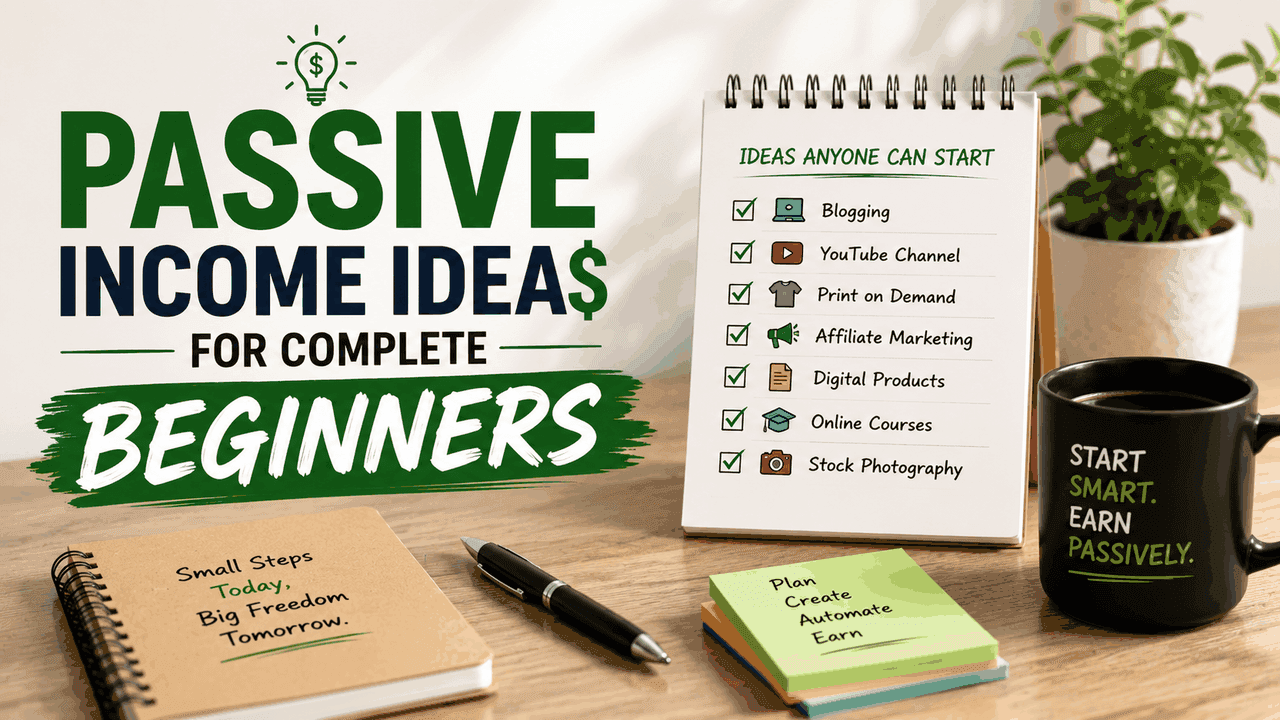
The mistake most beginners make is assuming passive income requires passive capital. It does not. It requires upfront value creation, and that value can come from your time, your skills, or your existing assets just as easily as from your wallet. This guide breaks down passive income ideas organized by exactly how much money you need to start: $0, $0–$100, or $100–$500. Every idea includes real 2026 earning data, the honest upfront work required, and a realistic timeline to your first dollar.
If you are not yet clear on what passive income actually means or how it differs from a side hustle, start with our guide on what is passive income, really — it covers the IRS definition, the three types of income, and why "passive" is never fully hands-off. If you want a broader list of beginner-friendly ideas across all capital levels, our guide on beginner passive income ideas that actually work covers 11 streams with full detail tables.
What "Little to No Money" Actually Means
Before diving into the ideas, let us be precise about the capital tiers. "No money" means you can start with a computer, an internet connection, and free tools. "Little money" means you might spend $50–$500 on tools, platforms, or initial inventory — but nothing that requires a loan, a credit card balance, or dipping into your emergency fund.
| Capital Tier |
What You Need |
What You Do NOT Need |
| $0 |
Computer, internet, free tools (Canva, Google Docs, Gumroad free tier) |
Savings, credit, paid software, inventory |
| $0–$100 |
Above plus small purchases (domain name, Canva Pro trial, hosting) |
Significant investment capital, loans, property down payments |
| $100–$500 |
Above plus modest investments (brokerage account, crowdfunding minimum, used equipment) |
Real estate down payments, business loans, premium ad spend |
💡 Pro tip: The most dangerous myth in the no-money passive income space is that you can build significant income with zero effort. You cannot. What you can do is replace capital with time. A $5,000 investment in dividend stocks might generate $200 per year with near-zero effort. A digital product that took 40 hours to create might generate $2,000 per year with 2 hours of monthly maintenance. The hourly return on your upfront time is often higher than the return on modest capital — but only if you actually do the work.
🌱 Tier 1: $0 Capital Required — Trade Time for Income
These ideas require no financial investment beyond what you already own. They demand significant upfront time — typically 20–60 hours before the first dollar arrives — but they are genuinely accessible to anyone starting from zero.
1. Create and Sell Digital Products
Digital products are the highest-earning-per-hour passive income stream for people with zero capital. You create something once — a budget spreadsheet, a resume template, a social media content calendar, a Notion dashboard — and it sells repeatedly with no additional production cost. The digital products market is projected to hit $920 billion by 2033, and the barrier to entry has never been lower.
A $15 budget template that took 10 hours to build and sells 20 copies a month generates $300 in monthly revenue. A comprehensive $49 online course that took 60 hours to create and sells 10 copies a month generates $490. The math compounds as you add more products.
| Detail |
Info |
| Earnings potential |
$100–$5,000+/month once established |
| Upfront time |
10–60 hours per product |
| Upfront capital |
$0 (Canva free tier, Google Docs, Gumroad/Etsy free listings) |
| Time to first sale |
2–6 weeks |
| Ongoing effort |
2–5 hours/month (marketing, customer support, updates) |
| Best platforms |
Etsy, Gumroad, Teachers Pay Teachers, Creative Market |
What actually sells in 2026: Budget spreadsheets for specific niches (freelancers, students, parents), resume templates for specific industries, social media content calendars for small businesses, meal planners for dietary restrictions, wedding planning checklists, and niche study guides. The narrower your product, the less competition you face. A "weekly planner for remote workers with ADHD" outperforms a generic "productivity bundle" because it targets a specific person with a specific problem.
💡 Pro tip: Search Etsy for your product idea before creating it. If the top 3 listings have 500+ reviews, the market is proven but saturated. If they have 10–50 reviews, you have found an underserved niche. That is where zero-capital beginners win — not by outspending competitors, but by out-niching them.
2. Affiliate Marketing Through Free Platforms
Affiliate marketing lets you earn commissions by promoting other companies' products through unique tracking links. You do not need your own product, your own inventory, or your own customer service. You need an audience — even a small one — and content that genuinely helps people make buying decisions.
The income is semi-passive because the content that drives clicks requires occasional updates, but once a blog post, YouTube video, or Pinterest pin ranks and generates traffic, the commissions roll in with minimal ongoing work. A beginner affiliate blog earning $200–$500 per month in year one is realistic. Several well-ranking posts can push that to $1,000+ by year two.
| Detail |
Info |
| Earnings potential |
$100–$10,000+/month (year 1: $200–$500 is realistic) |
| Upfront time |
20–60 hours (content creation + basic SEO) |
| Upfront capital |
$0 (use free platforms like Medium, Pinterest, TikTok, YouTube) or $50–$100 (hosting + domain for a blog) |
| Time to first commission |
3–12 months |
| Ongoing effort |
5–10 hours/month (content updates, link maintenance) |
| Best programs |
Amazon Associates, ShareASale, Impact, individual brand programs |
How beginners actually start without a blog: Create 10–20 detailed Pinterest pins or TikTok videos reviewing products in a niche you know. Add affiliate links in your bio or pin descriptions. Pinterest pins can drive traffic for years, and TikTok videos can go viral with zero followers if the content is genuinely helpful. A single viral "best budgeting apps for freelancers" TikTok can generate hundreds of affiliate clicks and dozens of commissions.
💡 Pro tip: The fastest way to earn your first affiliate commission is to target specific, low-competition search phrases. "Best budgeting app for freelancers" has less competition and higher conversion than "best budgeting app." Specificity ranks faster, converts better, and requires less authority to compete. For a full breakdown of how blogging and affiliate income scale over time, see our guide on how to make money from a blog tier by tier.
3. Print-on-Demand Products
Print-on-demand lets you sell custom-designed products — t-shirts, mugs, tote bags, phone cases — without holding inventory. You upload a design, a customer orders the product, and a fulfillment partner handles printing, packaging, and shipping. You never touch the product, never buy inventory upfront, and never handle returns.
A single popular design can sell 50–200 copies per month across multiple products, generating $200–$800 in profit with zero ongoing effort beyond occasional design updates. The key is niching down. A mug that says "Introverted but willing to discuss data" targets a specific audience and converts at 3–5x the rate of generic "coffee lover" designs.
| Detail |
Info |
| Earnings potential |
$200–$3,000+/month (scales with design volume) |
| Upfront time |
20–40 hours (design creation + store setup) |
| Upfront capital |
$0 (most platforms are free to join) |
| Time to first sale |
2–6 weeks |
| Ongoing effort |
2–4 hours/month (new designs, trend monitoring) |
| Best platforms |
Printful, Printify, Redbubble, Etsy + Shopify integration |
4. Self-Publish on Amazon KDP
Amazon Kindle Direct Publishing lets you publish ebooks and print-on-demand paperbacks for free. You write the book, format it, upload it, and Amazon handles printing, shipping, and customer service. You earn royalties of 35–70% per sale depending on pricing and format.
You do not need a literary agent or a publishing deal. You need a specific topic people search for, a clear outline, and the discipline to write 15,000–30,000 words. Low-content books — journals, planners, logbooks — require even less writing and sell consistently.
| Detail |
Info |
| Earnings potential |
$100–$2,000+/month per book |
| Upfront time |
40–100 hours (writing + formatting + cover design) |
| Upfront capital |
$0–$50 (Canva for cover design; optional formatting tools) |
| Time to first royalty |
2–4 weeks after publishing |
| Ongoing effort |
1–3 hours/month (ads, reviews, updated editions) |
| Best platform |
Amazon KDP |
What sells for beginners: Niche how-to guides, low-content planners, and compilations of useful information. A "Freelance Tax Deduction Checklist for 2026" ebook solves a specific, time-sensitive problem. A generic "how to be successful" ebook solves nothing specific and sells nothing.
5. YouTube Content (Evergreen Topics)
YouTube is one of the most accessible zero-capital passive income platforms in 2026. You create a video once, and it can generate ad revenue, affiliate commissions, and sponsorship income for years. YouTube Shorts, in particular, have lower production barriers and can reach massive audiences with minimal equipment.
Ad revenue typically pays $1–$5 per 1,000 views depending on the niche. A finance or tech channel with 10,000 monthly views might earn $30–$150 from ads alone, plus affiliate commissions from product mentions in the video description. The income is semi-passive because you need to publish consistently to grow, but older videos continue earning long after upload.
| Detail |
Info |
| Earnings potential |
$500–$10,000+/month (after monetization threshold) |
| Upfront time |
5–20 hours per video |
| Upfront capital |
$0 (smartphone camera + free editing software like CapCut or DaVinci Resolve) |
| Time to monetization |
6–12 months (need 1,000 subscribers + 4,000 watch hours) |
| Ongoing effort |
5–10 hours/week (content creation, community management) |
| Monetization |
AdSense, affiliate links, sponsorships, memberships |
6. Sell Stock Photos and Videos
If you already own a smartphone with a decent camera, you can sell photos and videos to stock platforms like Shutterstock, Adobe Stock, and iStock. Each time someone licenses your image, you earn a royalty — typically $0.01 to $2 per photo per sale, but popular images can sell hundreds or thousands of times.
The income is genuinely passive after upload. A portfolio of 500 high-quality images can generate $100–$500 per month in royalties with zero ongoing effort. The key is volume and relevance: trending themes like remote work, sustainability, and diversity in business settings sell consistently.
| Detail |
Info |
| Earnings potential |
$100–$2,000+/month (scales with portfolio size) |
| Upfront time |
2–5 hours per batch of 50 photos |
| Upfront capital |
$0 (smartphone camera works; optional $0–$500 for DSLR) |
| Time to first sale |
1–3 months |
| Ongoing effort |
2–4 hours/month (uploading new batches) |
| Best platforms |
Shutterstock, Adobe Stock, iStock, Getty Images |
7. Advertise on Your Car
If you own a car and drive regular routes, companies like Wrapify and Carvertise will pay you $100–$400 per month to wrap your vehicle in advertising. The company designs, produces, and installs the wrap at no cost to you. You drive your normal routes and collect the payment.
This is one of the few truly passive income ideas that requires no skills, no content creation, and no upfront time beyond the application process. The main requirement is driving enough miles in eligible areas.
| Detail |
Info |
| Earnings potential |
$100–$400/month |
| Upfront time |
1–2 hours (application + wrap installation) |
| Upfront capital |
$0 |
| Time to first payment |
2–4 weeks after campaign starts |
| Ongoing effort |
Zero — just drive your normal routes |
| Best platforms |
Wrapify, Carvertise, Nickelytics |
🌿 Tier 2: $0–$100 Capital — Small Investments That Start Working Immediately
These ideas require a small amount of starting capital — typically $50–$100 — but minimal ongoing effort. They are ideal for beginners who have saved a small amount and want to put their money to work while they focus on time-based streams from Tier 1.
8. High-Yield Savings Accounts and CDs
For risk-averse beginners, high-yield savings accounts (HYSAs) and certificates of deposit (CDs) offer truly passive income with zero effort after setup. In 2026, HYSAs pay roughly 4% APY, while the national average savings rate sits at 0.39%. CDs offer rates above 4.3% for one-year terms and up to 5.5% for longer terms.
The income is small but guaranteed. A $2,500 emergency fund in a 4% HYSA generates $100 per year — about $8 per month. A $5,000 one-year CD at 4.3% generates $215 in guaranteed interest. It will not change your life, but it beats letting cash sit in a 0.01% checking account, and it requires zero ongoing effort.
| Detail |
Info |
| High-yield savings APY |
~4% |
| National average savings APY |
~0.39% |
| CD rates (1–5 year terms) |
4.3%–5.5% |
| Income on $2,500 at 4% |
$100/year ($8/month) |
| Income on $5,000 at 4.3% |
$215/year ($18/month) |
| Upfront capital |
Any amount — no minimum for most HYSAs |
| Time to first interest |
Monthly (HYSA) or at maturity (CD) |
| Ongoing effort |
Zero |
| Best providers |
Marcus by Goldman Sachs, Ally, Discover, Capital One 360 |
💡 Pro tip: Use HYSAs for your emergency fund and short-term savings only. They are wealth-preservation tools, not wealth-building tools. The real value is psychological: knowing your cash is earning something while you build higher-return streams removes the urgency to chase risky investments.
9. Dividend-Focused ETFs (With Fractional Shares)
Dividend investing is one of the most accessible capital-based passive income streams, and fractional shares have made it available to beginners with as little as $1. You buy shares of companies or funds that pay regular dividends, and those dividends arrive quarterly without any action from you.
The S&P 500 average dividend yield is roughly 1.3% in 2026, but dividend-focused ETFs like SCHD yield 3.5–4.0%. At a 4% yield, a $100 investment generates $4 per year — modest, but it is the start of a compounding engine. A beginner who invests $100 per month into a 4% dividend ETF will have roughly $1,300 invested after one year, generating $52 per year in dividends. After five years of consistent contributions, that portfolio generates $260 per year — about $22 per month — and continues growing.
| Detail |
Info |
| S&P 500 average yield |
~1.3% |
| Dividend ETF yield (SCHD) |
3.5%–4.0% |
| Income on $100 at 4% |
$4/year |
| Income on $500 at 4% |
$20/year |
| Upfront capital |
$1+ per share (fractional shares available) |
| Time to first dividend |
Next quarterly payout after purchase |
| Ongoing effort |
Near zero — occasional rebalancing |
| Best platforms |
Fidelity, Vanguard, Schwab, Robinhood |
💡 Pro tip: Beginners often chase high-yield stocks paying 8–10% and get burned when the company cuts the dividend or the stock price collapses. Stick to diversified dividend ETFs or established dividend aristocrats with 25+ consecutive years of increases. Boring beats flashy when you are building your first capital base.
10. REITs (Real Estate Investment Trusts)
REITs let you invest in real estate without buying property. These trusts own income-producing real estate — apartments, warehouses, retail spaces, data centers — and pay dividends from the rent and profits. Because REITs trade like stocks, you can start with the price of a single share, often $10–$100.
In 2026, REIT dividend yields range from roughly 4% to 8% annually. A $100 investment in a 5% yield REIT generates $5 per year. That sounds tiny, but it is real estate exposure with no tenant calls, no property taxes to calculate, and no maintenance headaches. For beginners who want real estate income without real estate capital, REITs are the entry point.
| Detail |
Info |
| Annual dividend yield |
4%–8% |
| Income on $100 at 5% |
$5/year |
| Income on $500 at 5% |
$25/year |
| Upfront capital |
$10–$100 per share |
| Time to first dividend |
Immediate (next quarterly payout) |
| Ongoing effort |
Near zero |
| Best options |
VNQ (Vanguard Real Estate ETF), individual REITs like Realty Income (O) |
🌳 Tier 3: $100–$500 Capital — Modest Investments for Higher Returns
These ideas require more upfront capital but offer higher income potential and faster returns. They are best suited for beginners who have built a small savings cushion and want to accelerate their passive income growth.
11. Peer-to-Peer Lending
Peer-to-peer lending platforms like LendingClub connect you with borrowers who need loans. You lend small amounts ($25–$100 per loan) across many borrowers to spread risk, and you earn interest as they repay. Returns typically range from 4% to 12% annually depending on the risk grade of the loans you fund.
The risk is real — borrowers default, and your principal is not FDIC-insured. But for beginners with a small amount of speculative capital, P2P lending offers higher returns than savings accounts with more transparency than most alternative investments.
| Detail |
Info |
| Annual return potential |
4%–12% |
| Income on $500 at 7% |
$35/year |
| Upfront capital |
$25 minimum per loan note |
| Time to first interest payment |
Monthly as borrowers repay |
| Ongoing effort |
Low — platform automates most of the process |
| Best platforms |
LendingClub, Prosper |
12. Real Estate Crowdfunding
Real estate crowdfunding platforms like Fundrise, RealtyMogul, and Yieldstreet let you invest in commercial and residential real estate projects with as little as $500–$1,000. You pool your money with other investors, the platform manages the property, and you receive quarterly or monthly distributions from rental income and eventual property sales.
Returns typically range from 8% to 12% annually, though they vary by project and market conditions. The key advantage for beginners is access to institutional-quality real estate deals that would otherwise require hundreds of thousands of dollars.
| Detail |
Info |
| Annual return potential |
8%–12% |
| Income on $500 at 10% |
$50/year |
| Upfront capital |
$500–$1,000 minimum |
| Time to first distribution |
1–3 months after investment |
| Ongoing effort |
Near zero — platform handles everything |
| Best platforms |
Fundrise, RealtyMogul, Yieldstreet |
💡 Pro tip: Real estate crowdfunding is illiquid. Most platforms lock your capital for 3–5 years. Do not invest money you might need in the next two years. This is a "set it and forget it" play for long-term savings, not your emergency fund.
13. Rent Out Assets You Already Own
If you own a car, camera equipment, tools, or even storage space, peer-to-peer rental platforms let you monetize those assets without selling them. Turo lets you rent your car to travelers. Fat Llama lets you rent cameras, drones, and tools. Neighbor lets you rent out garage or basement storage space.
A Turo host in a tourist-heavy city earns an average of $800 per month renting out a spare car, with minimal maintenance time. A photographer renting a professional camera kit on Fat Llama can earn $50–$150 per rental day. The income is genuinely passive because the platform handles booking, insurance, and payment processing.
| Detail |
Info |
| Car rental (Turo) |
$500–$1,500+/month depending on location and vehicle |
| Equipment rental (Fat Llama) |
$50–$150 per rental day |
| Storage rental (Neighbor) |
$100–$500/month depending on space size |
| Upfront capital |
$0 — you already own the asset |
| Time to first rental |
Days to 2 weeks |
| Ongoing effort |
Low — platform handles most logistics |
Real-World Scenarios: Building Passive Income From Zero
Here are three realistic starting points for people with different resources. Each shows how combining one Tier 1 idea with one Tier 2 or Tier 3 idea produces meaningful income within 12 months.
Scenario 1: The College Student With $0 and 15 Hours/Week
Aisha is a college student with no savings and 15 hours per week to dedicate to passive income. She chooses digital products (Tier 1) and a high-yield savings account (Tier 2, funded by her part-time job).
| Stream |
Action |
Month 3 |
Month 6 |
Month 12 |
| Digital products |
Creates 3 student budget templates, lists on Etsy |
$60/month |
$220/month |
$400/month |
| HYSA |
Moves $1,500 emergency fund to 4% HYSA |
$5/month |
$5/month |
$5/month |
| Total monthly passive income |
|
$65/month |
$225/month |
$405/month |
By month 12, Aisha is earning $405 per month from work she did months ago. The digital products keep selling, the HYSA keeps paying interest, and her income grows as she adds more products. This is realistic zero-capital passive income: modest at first, but compounding steadily.
Scenario 2: The Single Parent With $200 Saved and 5 Hours/Week
Carlos is a single parent working full-time with $200 in savings and only 5 hours per week. He needs income that fits around his unpredictable schedule. He chooses print-on-demand (Tier 1) and invests $200 in a dividend ETF (Tier 2).
| Stream |
Action |
Month 3 |
Month 6 |
Month 12 |
| Print-on-demand |
Designs 12 niche products, lists on Etsy/Redbubble |
$35/month |
$120/month |
$250/month |
| Dividend ETF |
Invests $200 in SCHD, adds $50/month |
$1/month |
$3/month |
$10/month |
| Total monthly passive income |
|
$36/month |
$123/month |
$260/month |
Carlos's income starts small because both streams take time to compound. But by month 12, his print-on-demand designs are generating consistent sales, and his dividend portfolio has grown to $800 through monthly contributions. The total is modest, but it is $260 per month he was not earning before — and it requires only 5 hours per week of ongoing effort.
Scenario 3: The Recent Graduate With $400 Saved and 10 Hours/Week
Emma just graduated with $400 in savings and 10 hours per week. She wants to build passive income while job hunting. She chooses affiliate marketing through a niche blog (Tier 1) and invests $400 in real estate crowdfunding (Tier 3).
| Stream |
Action |
Month 3 |
Month 6 |
Month 12 |
| Affiliate blog |
Writes 10 posts targeting low-competition keywords |
$0 |
$45/month |
$180/month |
| Real estate crowdfunding |
Invests $400 in Fundrise |
$0 (first distribution at month 3) |
$3/month |
$4/month |
| Total monthly passive income |
|
$0 |
$48/month |
$184/month |
Emma's income is near zero for the first three months because both streams have setup delays. But by month 12, her blog posts are ranking and generating affiliate commissions, while her crowdfunding investment produces steady quarterly distributions. The key lesson: combining a slow-starting time-based stream with a slow-starting capital-based stream means a longer ramp-up, but both compound independently. Patience is the only requirement.
💡 Pro tip: Notice that none of these scenarios hits $1,000 per month in year one. That is the honest reality for most people starting from zero. The creators showing $10,000/month screenshots are typically 3–5 years into their journey, not 3–5 months. Beginners who accept the slow start and keep compounding are the ones who eventually reach those numbers. For a deeper look at how side hustles and passive income differ in timeline and effort, see our guide on passive income vs side hustle.
Common Mistakes When Starting With No Money
Trying to skip the upfront work. The most common mistake is expecting passive income to appear without the upfront effort that "passive" always demands. A digital product that took 2 hours to create will not sell. A blog post written in 20 minutes will not rank. The upfront work is the price of admission, and there is no way around it.
Chasing too many ideas at once. Launching five passive income streams simultaneously means mastering none. The most successful beginners pick one Tier 1 idea and one Tier 2 idea, focus on both for 12 months, and only expand once one is producing consistent income.
Ignoring the platform fees. Etsy charges $0.20 per listing plus 6.5% of each sale. Gumroad takes 10% of each transaction. Amazon KDP takes 30–65% of each sale depending on pricing. These fees are not hidden — they are published — but beginners often price their products without accounting for them, then wonder why their profit is lower than expected.
Giving up before month six. Digital products take 2–6 weeks to get their first sale. Affiliate blogs take 3–12 months to generate commissions. Dividend investing takes years to produce meaningful monthly income. Beginners who quit in month three because they are not earning $1,000 yet are quitting exactly when the compounding curve is about to bend upward.
Confusing passive income with get-rich-quick. There is no passive income stream that generates significant money with zero effort and zero capital. The trade-off is always upfront time or upfront capital. If someone promises both, they are selling something.
Bottom Line
How to generate passive income with no initial funds is not a fantasy. It is a math problem with a clear solution: replace capital with time, create upfront value that keeps selling, and give it the months the data says it actually takes.
If you have $0, start with digital products, affiliate marketing, print-on-demand, Amazon KDP, YouTube, or stock photography. Each requires 20–60 hours of upfront work but zero financial investment. If you have $0–$100, add a high-yield savings account, dividend ETFs, or REITs to put your small savings to work. If you have $100–$500, consider peer-to-peer lending, real estate crowdfunding, or renting out assets you already own.
The honest timeline for most beginners starting from zero is $50–$150 per month by month 6, $150–$400 per month by month 12, and $500+ per month only after 18–36 months of consistent effort and reinvestment. That is not discouraging — it is realistic. And realistic expectations are what separate the 12% of people who earn meaningful passive income from the 88% who try, get frustrated, and quit before the compounding kicks in.
Pick one idea from Tier 1 and one from Tier 2. Start this week. Track your numbers honestly. And give it the 12 months the data says it actually takes.
Frequently Asked Questions
How can I generate passive income with no initial funds?
You can start with digital products (templates, guides, printables), affiliate marketing, print-on-demand, Amazon KDP self-publishing, YouTube content, stock photography, or car advertising. All of these require zero upfront capital beyond a computer and internet connection. The trade-off is significant upfront time investment — typically 20–60 hours before the first dollar arrives.
What is the easiest passive income to start with no money?
High-yield savings accounts are the easiest — zero effort after setup, guaranteed returns, and no expertise required. But the income is small. For meaningful returns with zero capital, digital products and print-on-demand typically generate first sales within 2–6 weeks and scale without additional production costs.
How long does it take to earn passive income with no money?
Time-based streams like digital products and print-on-demand typically produce first sales within 2–6 weeks. Affiliate marketing and blogging take 3–12 months to generate meaningful commissions. YouTube takes 6–12 months to reach monetization thresholds. Capital-based streams like dividends and REITs pay immediately but require significant capital to produce meaningful monthly income. Most beginners see $100–$300 per month by month 6 and $300–$500 per month by month 12.
Can passive income replace my job if I start with no money?
Not in year one. Replacing a full-time income requires either significant capital or 18–36 months of consistent effort building time-based streams. Most people should treat passive income as a supplement first, then gradually grow it toward replacement level as it compounds. A realistic year-one goal is $300–$500 per month from a combination of one time-based and one capital-based stream.
What passive income mistakes should beginners with no money avoid?
The biggest mistakes are: expecting results without upfront effort, chasing too many streams at once, ignoring platform fees when pricing products, giving up before month six, and confusing passive income with get-rich-quick schemes. Another common error is trying to invest in capital-heavy streams like real estate when you have no capital — start with time-based streams instead.
How much can I realistically earn from passive income with no money?
It depends on your time investment and consistency. A digital product creator working 10 hours per week can realistically earn $200–$400 per month by month 12. An affiliate blogger working 5 hours per week might earn $100–$300 per month by month 12. A print-on-demand seller with 20 designs might earn $150–$350 per month by month 12. Combining two streams typically produces $300–$600 per month by year one.
Is peer-to-peer lending a good passive income idea for beginners?
Peer-to-peer lending offers 4–12% annual returns but carries real default risk — your principal is not FDIC-insured. It is best suited for beginners who have $500+ in speculative capital they can afford to lose, not for your emergency fund or rent money. Start with a small amount, diversify across many loans, and treat it as a higher-risk portion of a broader passive income strategy.
What is the fastest way to start earning passive income with no money?
The fastest paths are digital products and print-on-demand, which can generate first sales within 2–6 weeks. Car advertising is even faster — applications are approved within days and payments start within 2–4 weeks. However, car advertising caps at $100–$400 per month, while digital products and print-on-demand have much higher scaling potential.
Should I focus on one passive income stream or multiple?
Start with two: one time-based stream (like digital products or affiliate marketing) and one capital-based stream (like a high-yield savings account or dividend ETF). Master both for 12 months before adding a third. Beginners who launch five streams simultaneously typically master none and burn out before any of them produce meaningful income.
What is the best passive income idea for someone with no skills?
High-yield savings accounts and car advertising require no specialized skills. Print-on-demand requires only basic design sense (Canva templates help). Stock photography requires only a smartphone camera and an eye for trending subjects. Affiliate marketing requires only the ability to write or speak clearly about products you already use. None of these require a degree, certification, or prior experience.