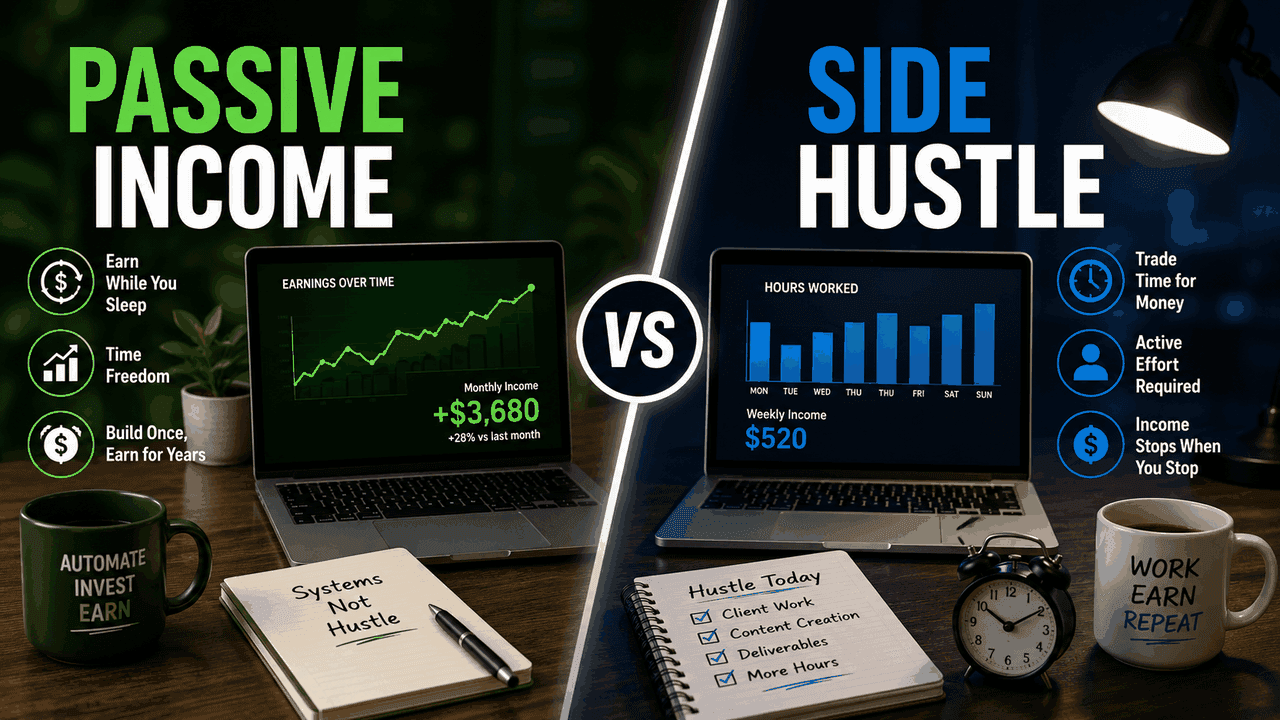
This guide breaks down exactly how passive income and side hustles differ, what each one actually pays in 2026, how they are taxed, and — most importantly — how to choose the right one for your current situation. If you are not yet clear on what passive income actually means under IRS rules, start with our guide on what is passive income, really — it covers the legal definition, the three types of income, and why "passive" is never fully hands-off.
What Is a Side Hustle? The Honest Definition
A side hustle is active work you do outside your main job to earn extra money. You trade your time, skills, or attention for income on a regular basis. If you stop working, the income stops. That is the defining trait, and it is non-negotiable.
In 2026, 33% of Americans report having an active side hustle, down slightly from 38% in 2025. But the intensity has increased — those who stick with it are earning more than ever. The average monthly side hustle income reached $1,242 in 2026 according to LendingTree data, though Bankrate's 2025 survey puts the average at $885 and the median at just $200. That wide gap between average and median is the key statistic: a small group of high earners pulls the average up, while the majority of side hustlers earn modest supplemental income.
| Side Hustle Statistic |
2026 Data |
| Americans with a side hustle |
33% (LendingTree), 39% (Side Hustle Nation) |
| Average monthly income |
$885–$1,242 |
| Median monthly income |
$200–$400 |
| Percentage earning $1,000+/month |
~10% |
| Percentage earning $50 or less/month |
~28% |
| Average hours per week |
8–10 hours |
| Burnout rate |
67% |
| Gen Z participation rate |
53–56% |
The most common side hustles in 2026 are gig and on-demand work (29%), freelance and professional services (26%), creative and content activities (23%), and home improvement or skilled trades (21%). Food delivery, ride-sharing, babysitting, pet sitting, online freelancing, tutoring, and e-commerce reselling dominate the list.
💡 Pro tip: The median side hustle income of $200 per month is not a failure — it is the baseline. Most side hustlers are not trying to replace their job. They are covering a car payment, building an emergency fund, or testing a business idea. The problem starts when people expect side hustle income to scale like passive income without putting in the systems that make scaling possible.
What Is Passive Income? A Quick Recap
Passive income is money earned with limited ongoing effort after an initial investment of time, money, or both. The income continues to flow even when you are not actively working. A dividend stock pays quarterly because you bought it months ago. A digital product sells while you sleep because you created it last year. A rental property generates monthly cash flow because you purchased it and set up management systems.
The critical distinction: passive income requires upfront value creation — either capital (buying assets) or labor (building systems) — before any money arrives. Side hustles pay immediately for work done today. Passive income pays later for work done yesterday. For a full breakdown of the IRS definition, the three types of income, and real earning examples, see our guide on what is passive income, really.
The Real Difference: Side Hustle vs Passive Income
Here is the side-by-side comparison that most guides skip. The differences are not just philosophical — they affect your taxes, your time, your burnout risk, and your earning ceiling.
| Factor |
Side Hustle |
Passive Income |
| How you earn |
Active time and effort |
Upfront setup or capital investment |
| Speed of first dollar |
Days to weeks |
Weeks to months, sometimes years |
| Ongoing work required |
Regular — typically 5–15 hours/week |
Minimal once established — 0–5 hours/week |
| Startup cost |
Usually low — $0 to $500 |
Ranges from $0 (time-based) to $50,000+ (capital-based) |
| Scalability |
Limited by your available hours |
Can compound over time without proportional effort |
| Income predictability |
Steady if you keep working |
Variable — market-dependent, algorithm-dependent, tenant-dependent |
| Burnout risk |
High — 67% report burnout |
Low — but requires patience through the setup phase |
| Tax treatment |
Self-employment income (Schedule C, 15.3% SE tax on $400+) |
Varies by type — ordinary income, capital gains, or passive activity rules |
| Example |
Freelance writing, food delivery, tutoring |
Dividends, rental income, digital product sales, REITs |
Think of it this way: a side hustle is like picking up extra shifts at a café. You get paid for the hours you work, and the pay stops when the shift ends. Passive income is like planting an orchard. You spend months preparing the soil, planting trees, and setting up irrigation. The first harvest takes years. But once the trees mature, they produce fruit every season with minimal ongoing effort.
Neither is inherently better. The question is which one fits your current resources, your risk tolerance, and your timeline.
Side-by-Side: 10 Real Examples Compared
Theory is useful. Concrete examples are better. Here are five common side hustles and five common passive income streams, compared on actual 2026 earnings, time requirements, and scalability.
Side Hustle Examples
| Side Hustle |
Monthly Earnings |
Hours/Week |
Scalable? |
Burnout Risk |
| Food delivery (DoorDash, Uber Eats) |
$200–$800 |
10–20 |
No — tied to hours worked |
High — physical, weather-dependent |
| Freelance writing |
$500–$3,000+ |
10–30 |
Partially — can raise rates but still trades time |
Moderate — creative burnout is common |
| Virtual assistant |
$400–$2,000 |
10–20 |
No — directly tied to client hours |
Moderate — repetitive tasks drain energy |
| Tutoring online |
$300–$1,500 |
5–15 |
No — one student at a time |
Low — but income caps quickly |
| Handyman / skilled trades |
$500–$2,500 |
5–15 |
Partially — can hire help but adds management |
High — physical labor, scheduling stress |
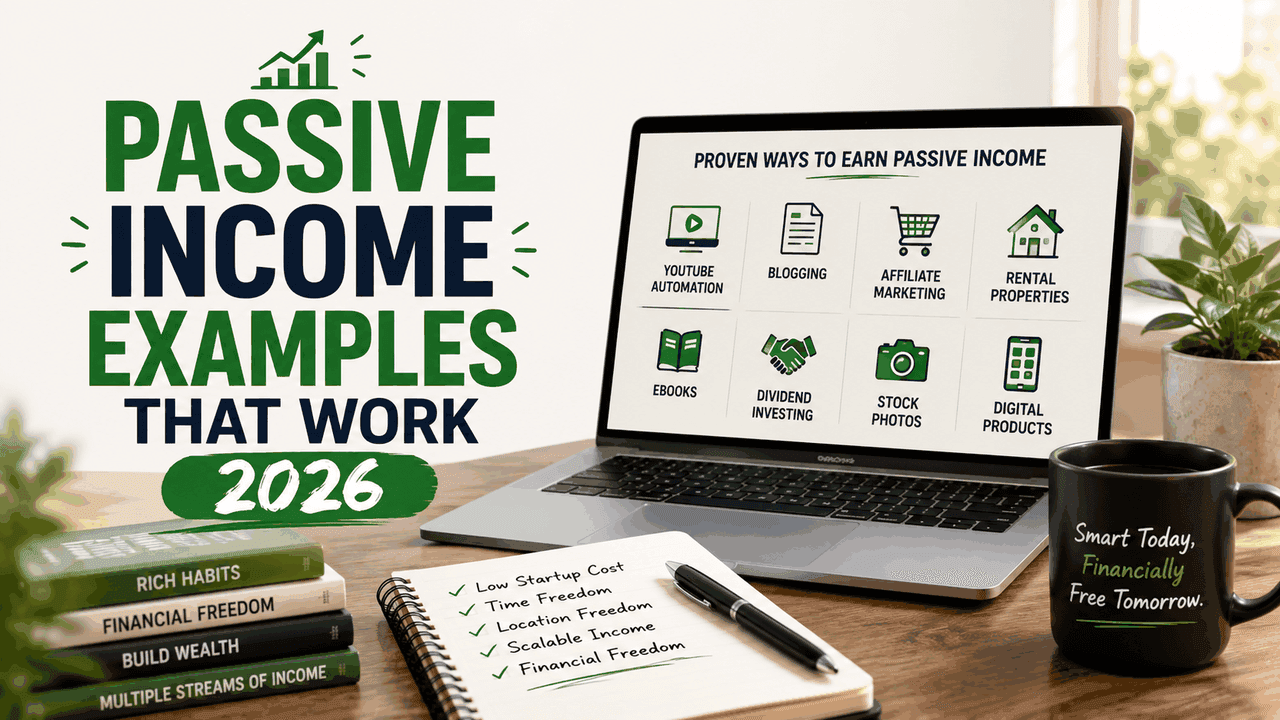
Passive Income Examples
| Passive Income Stream |
Monthly Earnings |
Hours/Week (After Setup) |
Scalable? |
Setup Time |
| Dividend ETF portfolio |
$17–$500+ depending on capital |
0–0.5 |
Yes — compounds with reinvestment |
Immediate after purchase |
| Rental property (managed) |
$200–$800 after expenses |
1–2 |
Yes — can acquire more properties |
1–3 months after purchase |
| Digital products (Etsy/Gumroad) |
$100–$5,000+ |
2–5 |
Yes — each sale costs nothing extra |
2–6 weeks to first sale |
| REIT investments |
$8–$100+ depending on capital |
0 |
Yes — compounds with reinvestment |
Immediate after purchase |
| Affiliate marketing blog |
$200–$5,000+ |
5–15 |
Yes — content keeps earning for years |
3–12 months to first commission |
The pattern is clear. Side hustles pay faster but cap out based on your available hours. Passive income pays slower but can grow without you working more hours. A freelance writer earning $75 per hour hits a ceiling at roughly 20 billable hours per week — about $6,000 per month before taxes and expenses. A blogger with 50 ranking affiliate posts can earn $2,000 per month while working 5 hours per week — our guide on how to make money from a blog tier by tier breaks down exactly how that traffic-to-dollar math works, and that income can grow to $5,000+ with the same effort as traffic compounds.
💡 Pro tip: The highest earners in 2026 are not choosing between side hustles and passive income — they are using both strategically. They run a side hustle for immediate cash flow, then funnel a portion of those earnings into passive income streams that compound over time. A freelance writer who invests 20% of her income into dividend ETFs and spends 5 hours per week building a digital product is building two income engines simultaneously.
Can a Side Hustle Become Passive Income? The Bridge Most People Miss
This is the most important section in this entire guide. The answer is yes — but only if you intentionally convert the side hustle into a system that does not require your ongoing time.
A side hustle becomes passive income when you remove yourself from the time-for-money exchange. Here is how that conversion actually works for the most common side hustles:
| Side Hustle |
Passive Conversion Path |
Timeline |
Effort Required |
| Freelance writing |
Build a team of writers, become an agency owner, or create templates/courses that sell without your direct involvement |
1–3 years |
High upfront — hiring, systems, quality control |
| Food delivery |
Save earnings, buy a rental property or dividend portfolio; delivery itself never becomes passive |
2–5 years |
Moderate — disciplined saving and investing |
| Graphic design |
Create design templates, stock assets, or a course teaching your process; sell on Creative Market or Gumroad |
6–18 months |
Moderate — product creation, then marketing |
| Tutoring |
Record your sessions, package them as a course on Udemy or Teachable; sell instead of teaching live |
3–6 months |
Moderate — course creation, platform setup |
| Virtual assistant |
Document your systems, hire and train VAs under you, become an agency owner |
1–2 years |
High — management, hiring, client retention |
The common thread is systematization. You are either replacing yourself with assets (digital products, investments) or with people (hired help, agencies). Neither path is easy, and neither happens by accident. A freelancer who simply works more hours is still a freelancer. A freelancer who builds a course, hires subcontractors, and invests 30% of earnings into dividend stocks is building passive income.
💡 Pro tip: If you are currently running a side hustle, ask yourself one question: "If I stopped working completely next month, how much of my income would continue?" If the answer is zero, you have a side hustle, not passive income. That is not a problem — it is a diagnosis. The treatment is picking one conversion path from the table above and working on it for 30 minutes a day.
Tax Treatment: Side Hustle vs Passive Income
How your extra income gets taxed depends entirely on which category it falls into. Getting this wrong costs money at tax time.
Side Hustle Tax Rules
Side hustle income is self-employment income. The IRS treats it as active business income, which means:
- You report it on Schedule C (Profit or Loss from Business)
- If your net earnings are $400 or more in a year, you owe self-employment tax of 15.3% on those earnings. This covers Social Security and Medicare. W-2 employees split this cost with their employers; self-employed individuals pay the full amount, though half can be deducted at tax time.
- You must make quarterly estimated tax payments if you expect to owe $1,000 or more in taxes for the year.
- You can deduct legitimate business expenses — home office, equipment, software, mileage, professional development — which reduces your taxable income.
| Side Hustle Tax Element |
What It Means |
| Schedule C |
Reports income and expenses for your side hustle |
| Self-employment tax |
15.3% on net earnings of $400+ |
| Quarterly estimates |
Required if you expect to owe $1,000+ in taxes |
| Deductible expenses |
Home office, equipment, software, mileage, professional fees |
| Tax burden (typical) |
25–40% of net income after deductions |
Passive Income Tax Rules
Passive income tax treatment varies by the type of income:
- Rental income: Taxed as ordinary income after deductible expenses (mortgage interest, property taxes, repairs, depreciation). Subject to passive activity loss rules — losses can only offset passive income, not wages, unless you qualify for the $25,000 special allowance.
- Dividends: Qualified dividends are taxed at long-term capital gains rates (0%, 15%, or 20% depending on income). Non-qualified dividends are taxed as ordinary income.
- Digital product sales: Taxed as ordinary business income if you are actively involved in creating and marketing the product. If the product sells through automation with minimal involvement, it may still be active income unless structured through a passive entity.
- REIT dividends: Typically taxed as ordinary income, though a portion may qualify for the 20% qualified business income deduction under Section 199A.
- Capital gains from selling passive assets: Taxed at long-term capital gains rates if held over one year.
| Passive Income Type |
Tax Rate |
Deductible Losses? |
Subject to Self-Employment Tax? |
| Rental income |
Ordinary income rates |
Yes — passive losses offset passive income; $25K allowance for active participants |
No |
| Qualified dividends |
0%, 15%, or 20% |
No |
No |
| Digital product sales (active creator) |
Ordinary income rates |
Business expenses only |
Yes — if actively creating and marketing |
| REIT dividends |
Ordinary income rates (mostly) |
No |
No |
| Long-term capital gains |
0%, 15%, or 20% |
Offset by capital losses |
No |
💡 Pro tip: The tax difference between side hustles and passive income can be significant. A side hustler earning $1,000 per month might owe $250–$400 in taxes after self-employment tax and income tax. A passive income investor earning $1,000 per month in qualified dividends might owe $0–$150 depending on their tax bracket. That is not tax avoidance — it is tax structure, and it is why understanding the difference matters for long-term wealth building.
The Burnout Problem: Why Side Hustles Break People
Here is a statistic that does not get enough attention: 67% of side hustlers report experiencing burnout. And 52% say the extra workload only feels worth it if they earn more than $500 per week — roughly $2,000 per month. That means more than half of side hustlers are working extra hours for income that, by their own admission, does not feel worth the trade-off.
The burnout is not just about hours worked. It is about the type of work. Side hustles that require real-time availability — food delivery, ride-sharing, tutoring, virtual assisting — do not allow for deep rest. You are always on call, always managing schedules, always trading tomorrow's energy for today's dollars. The gig economy, valued at $455 billion in 2026, runs on this exact trade-off.
| Burnout Factor |
Side Hustle Impact |
Passive Income Impact |
| Real-time availability |
Required — clients, platforms, and schedules demand it |
Not required — income flows without your presence |
| Income tied to hours worked |
Yes — every hour not worked is money not earned |
No — income is tied to systems and assets, not hours |
| Physical and mental exhaustion |
High — 67% report burnout |
Low — but requires patience through the slow setup phase |
| Relationship strain |
Common — extra work hours reduce family and social time |
Minimal — passive income does not compete for your evenings |
| Primary job performance risk |
Real — side hustlers report reduced focus at day jobs |
Minimal — passive income does not require active attention during work hours |
Passive income is not a magic cure for burnout. The setup phase can be stressful, and income variability creates its own anxiety. But once established, passive income does not demand your evenings, your weekends, or your mental bandwidth during your primary job. That is the real difference: side hustles consume your time. Passive income, properly built, protects it.
💡 Pro tip: If you are currently burned out from a side hustle, the answer is not to hustle harder. The answer is to convert one hour per day from active side hustle work to passive income building. In six months, that one hour per day — 180 hours total — is enough to create a digital product, write 20 blog posts, or research and purchase a dividend portfolio. Small, consistent shifts from active to passive work compound faster than you expect.
Real-World Scenarios: Choosing Between Side Hustle and Passive Income
Here are three realistic situations showing how the choice between side hustle and passive income plays out in practice.
Scenario 1: The Recent Graduate Who Needs Cash Now
Alex just graduated with $35,000 in student loans and a $45,000 starting salary. He needs extra income immediately to build an emergency fund and start paying down debt. He has minimal savings and 10 hours per week to dedicate to extra work.
| Approach |
Month 1 |
Month 6 |
Month 12 |
Effort/Week |
| Side hustle: Freelance writing |
$400 |
$800 |
$1,200 |
10 hours |
| Passive income: Dividend investing |
$0 |
$5 |
$15 |
1 hour |
| Combined strategy |
$400 |
$805 |
$1,215 |
11 hours |
Alex needs the side hustle for immediate cash flow. But he also allocates $100 per month from his side hustle earnings into a dividend ETF. By month 12, his writing income covers his extra expenses while his dividend portfolio begins compounding. This is the correct approach for someone who needs money now but also wants to build long-term wealth.
Scenario 2: The Parent With Unpredictable Schedules
Maria is a stay-at-home parent with two young children. Her available time is fragmented — nap times, school pickups, and unpredictable interruptions. She has $2,000 in savings and cannot commit to client deadlines or scheduled shifts.
| Approach |
Month 1 |
Month 6 |
Month 12 |
Effort/Week |
| Side hustle: Virtual assistant |
$300 |
$600 |
$900 |
10 hours (unreliable) |
| Passive income: Digital products + REITs |
$0 |
$150 |
$400 |
5 hours (flexible) |
Maria tried virtual assisting but missed two client deadlines due to a sick child. She shifted to creating digital products — budget templates for parents — during nap times, and invested $1,000 in REITs. By month 12, her digital products generate $300 per month with no deadlines, and her REITs add another $100. The total is lower than the VA route, but it is sustainable around her actual life. For parents in similar situations, side hustles designed for stay-at-home parents often blend well with the semi-passive digital product approach.
Scenario 3: The Mid-Career Professional Building Toward Financial Independence
James earns $85,000 per year, has maxed out his 401(k), and has $15,000 in extra savings. He wants to build income that compounds toward early retirement. He has 5 hours per week and does not need immediate cash.
| Approach |
Month 1 |
Month 6 |
Month 12 |
Year 3 |
| Side hustle: Consulting |
$2,000 |
$2,000 |
$2,000 |
$2,000 (capped by hours) |
| Passive income: Rental property crowdfunding + dividend growth |
$50 |
$100 |
$200 |
$600+ (compounding) |
| Combined strategy |
$2,050 |
$2,100 |
$2,200 |
$2,600+ |
James runs a small consulting side hustle for immediate high income, but he is deliberately capping it at 5 hours per week. The bulk of his extra time goes into researching and building passive income streams — real estate crowdfunding, dividend growth investing, and a niche affiliate site. By year 3, his passive income has grown to $600 per month without additional effort, while his consulting income stays flat. This is the wealth-building approach: use active income to fund passive assets, then let the assets compound.
How to Choose: Side Hustle, Passive Income, or Both
The decision is not either-or. Most people who build real financial security use both, but in a specific sequence.
Choose a side hustle if:
- You need extra income within the next 30 days
- You have a skill that commands $30+ per hour
- You have 10+ hours per week of predictable availability
- You are using the income to fund passive income investments
Choose passive income if:
- You have 6–12 months before you need the money
- You have capital to invest ($500+) or expertise to package into a product
- Your available time is unpredictable or fragmented
- You are building toward long-term financial independence, not short-term cash flow
Choose both if:
- You need immediate income but also want long-term wealth
- You can dedicate 5 hours per week to active work and 5 hours to passive building
- You are willing to delay gratification for 12–24 months while both streams mature
| Your Situation |
Best Starting Point |
Why |
| Need cash in 30 days |
Side hustle (freelancing, gig work) |
Pays immediately for effort invested |
| Unpredictable schedule |
Passive income (digital products, investing) |
Does not require real-time availability |
| $5,000+ in savings |
Passive income (dividends, REITs, crowdfunding) |
Capital can start working immediately |
| $0 in savings, 15+ hours/week |
Side hustle → convert to passive |
Earn first, then build systems |
| Building toward FI/RE |
Both — side hustle funds passive assets |
Active income accelerates passive compounding |
💡 Pro tip: The most common mistake is trying to build passive income when you actually need a side hustle, or grinding at a side hustle when you should be building passive systems. Be honest about your timeline. If your rent is due in 30 days, start with a side hustle. If you have a 6-month emergency fund and want to build wealth, shift your focus to passive income. For a full list of beginner-friendly passive income ideas that match different capital levels, see our guide on beginner passive income ideas that actually work.
Bottom Line
Passive income vs side hustle is not a competition. It is a sequence. Most people start with a side hustle because they need money now. The smart ones use that side hustle income to build passive income systems that pay them later. The ones who never make the transition stay stuck trading hours for dollars indefinitely.
The 2026 data is clear: 33% of Americans have a side hustle, but only 10% earn more than $1,000 per month from it, and 67% report burnout. Meanwhile, the 12% who earn meaningful passive income share a different pattern — they accepted the slow start, built systems instead of just working harder, and gave their investments and products time to compound.
A side hustle pays your bills this month. Passive income pays your bills five years from now without you clocking in. The fastest path to real financial security is not choosing one over the other — it is using a side hustle to fund passive income, then gradually shifting your energy from active work to compounding assets. Start with what you need today. Build what you will need tomorrow.
Frequently Asked Questions
What is the difference between a side hustle and passive income?
A side hustle is active work you do outside your main job — you trade time for money, and the income stops when you stop working. Passive income is money that continues to flow after an initial investment of time or capital, with minimal ongoing effort. Side hustles pay now. Passive income pays later.
Is a side hustle passive income?
No. By definition, a side hustle requires ongoing active work. However, some side hustles can be converted into passive income over time — for example, a freelance writer who creates a course, or a tutor who records lessons and sells them instead of teaching live. The conversion requires intentional system-building, not just working more hours.
Can a side hustle become passive income?
Yes, but it requires removing yourself from the time-for-money exchange. Common conversion paths include: creating digital products from your expertise, hiring subcontractors to do the client work while you manage, or investing side hustle earnings into dividend stocks, REITs, or rental properties. Most conversions take 6 months to 3 years.
Which pays more: side hustles or passive income?
In the short term, side hustles almost always pay more. The average side hustler earns $885 per month within weeks of starting. Passive income typically takes 3–12 months to generate meaningful cash flow. In the long term, passive income often wins because it compounds without additional hours — a blogger earning $2,000 per month from 50 posts works fewer hours than a freelancer earning the same amount.
How are side hustles taxed compared to passive income?
Side hustle income is self-employment income, reported on Schedule C, and subject to 15.3% self-employment tax on earnings of $400 or more. Passive income tax treatment varies: rental income is ordinary income with passive loss rules; qualified dividends get lower capital gains rates; REIT dividends are mostly ordinary income; digital product sales are ordinary business income if you are actively involved. The tax burden on side hustles is typically higher.
What are examples of active vs passive income?
Active income examples: wages from a job, freelance writing fees, consulting income, food delivery earnings, tutoring payments. Passive income examples: rental property income, dividend payments, REIT distributions, digital product sales, affiliate commissions from evergreen content, interest from CDs and savings accounts.
Why do side hustles cause burnout?
67% of side hustlers report burnout because the work requires real-time availability, trades hours directly for dollars, and competes with primary job responsibilities and personal time. Unlike passive income, side hustles do not allow you to step away without immediate income loss. The psychological pressure of always needing to work creates exhaustion that passive income, once established, does not.
Should I start a side hustle or build passive income first?
Start with a side hustle if you need cash within 30 days. Start with passive income if you have 6–12 months of financial cushion and want to build long-term wealth. The most effective long-term strategy is usually both: use a side hustle for immediate cash flow, then funnel 20–30% of those earnings into passive income streams that compound over time.
How long does it take for a side hustle to become passive income?
The timeline varies by the conversion path. Creating a digital product from your expertise takes 2–6 months. Building a course from tutoring or coaching material takes 3–6 months. Hiring subcontractors to replace yourself takes 1–2 years. Investing side hustle earnings into dividend stocks or REITs starts producing passive income immediately but requires significant capital to generate meaningful monthly returns.
What is the best side hustle to convert into passive income?
The best candidates are expertise-based side hustles that can be productized: freelance writing (create templates and courses), graphic design (sell design assets), tutoring (record and sell courses), consulting (package frameworks into digital products), and web development (sell templates or plugins). Gig work like food delivery and ride-sharing are the hardest to convert because they do not produce reusable assets or intellectual property.