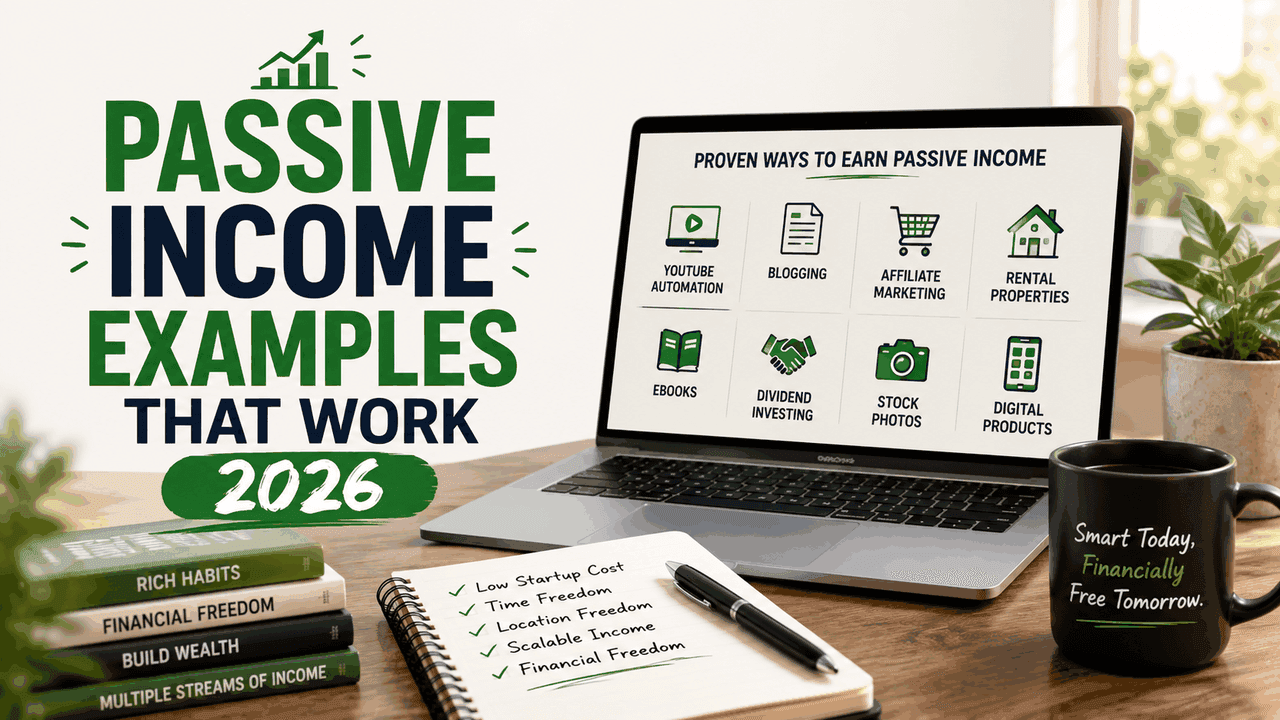
The Three Types of Passive Income: Capital, Assets, and Creation
Before diving into specific examples, it helps to understand the three models that generate virtually all passive income. Each model requires a different starting resource, produces income on a different timeline, and scales differently.
| Model |
What You Need |
How It Works |
Timeline to Income |
| Capital-based |
Money to invest |
Your money generates returns through dividends, interest, or appreciation |
Immediate (but small without large capital) |
| Asset-based |
Physical assets you own |
Existing assets produce revenue through rentals, licensing, or leasing |
Days to weeks |
| Creation-based |
Time and expertise |
You build something once that sells repeatedly without additional production |
Weeks to months |
Most people who earn meaningful passive income run at least two of these models simultaneously. A capital-based stream provides steady, low-effort returns. A creation-based stream provides higher per-hour returns but requires upfront work. An asset-based stream monetizes things you already own. The combination smooths out the weaknesses of any single model.
💡 Pro tip: The fastest way to build meaningful passive income is not finding the one perfect example. It is picking one example from each model, mastering all three, and letting them compound together. A dividend portfolio earning $200 per month, a digital product earning $400 per month, and a rented parking space earning $150 per month combine into $750 per month — a figure that takes years to reach with any single stream alone.
Capital-Based Passive Income Examples
These examples require money to start. The income is genuinely passive — near-zero ongoing effort — but the returns are proportional to your capital. A $1,000 investment produces modest income. A $100,000 investment produces meaningful income.
1. Dividend-Focused ETFs
Dividend investing is the most accessible capital-based passive income stream. You buy shares of companies or funds that pay regular dividends, and those dividends arrive in your account quarterly without any action from you. The S&P 500 average dividend yield sits around 1.3% in 2026, but dividend-focused ETFs like SCHD yield 3.5–4.0%, and individual dividend aristocrats — companies with 25+ consecutive years of dividend increases — often yield 3–5%.
The math is straightforward but sobering. At a 4% yield, a $10,000 investment generates $400 per year — about $33 per month. A $50,000 investment generates $2,000 per year — about $167 per month. A $300,000 investment generates $12,000 per year — $1,000 per month. This is why dividend investing is a long-term wealth-building strategy, not a quick cash solution.
| Detail |
Typical Range |
| S&P 500 average yield |
~1.3% |
| Dividend ETF yield (SCHD) |
3.5%–4.0% |
| Dividend aristocrat yield |
3%–5% |
| Income on $10,000 at 4% |
$400/year ($33/month) |
| Income on $50,000 at 4% |
$2,000/year ($167/month) |
| Income on $300,000 at 4% |
$12,000/year ($1,000/month) |
| Upfront capital |
$1+ per share (fractional shares available) |
| Time to first dividend |
Next quarterly payout after purchase |
| Ongoing effort |
Near zero — occasional rebalancing |
| Best platforms |
Fidelity, Vanguard, Schwab, Robinhood |
2. REITs (Real Estate Investment Trusts)
REITs let you invest in real estate without buying property. These trusts own income-producing real estate — apartments, warehouses, retail spaces, data centers — and pay dividends from the rent and profits. Because REITs trade like stocks, you can start with the price of a single share, often $10–$100.
In 2026, REIT dividend yields range from roughly 4% to 8% annually. A $10,000 investment in a 5% yield REIT generates $500 per year — about $42 per month. The key advantage is real estate exposure without tenant calls, property taxes to calculate, or maintenance headaches. For beginners who want real estate income without real estate capital, REITs are the entry point.
| Detail |
Typical Range |
| Annual dividend yield |
4%–8% |
| Income on $5,000 at 5% |
$250/year ($21/month) |
| Income on $10,000 at 5% |
$500/year ($42/month) |
| Upfront capital |
$10–$100 per share |
| Time to first dividend |
Immediate (next quarterly payout) |
| Ongoing effort |
Near zero |
| Best options |
VNQ (Vanguard Real Estate ETF), individual REITs like Realty Income (O) |
3. High-Yield Savings Accounts and CDs
For risk-averse earners, high-yield savings accounts and certificates of deposit offer truly passive income with zero effort after setup. In 2026, high-yield savings accounts pay about 4% APY, while the national average sits at 0.39%. CDs still offer rates above 4.3% for one-year terms and up to 5.5% for longer terms.
The trade-off is scale. A $10,000 emergency fund in a 4% HYSA generates $400 per year — about $33 per month. It is passive, it is safe, and it is guaranteed. But it will not replace your job. The real value is as a wealth-preservation tool, not a wealth-building tool.
| Detail |
Typical Range |
| High-yield savings APY |
~4% |
| National average savings APY |
~0.39% |
| CD rates (1–5 year terms) |
4.3%–5.5% |
| Income on $10,000 at 4% |
$400/year ($33/month) |
| Upfront capital |
Any amount — no minimum for most HYSAs |
| Time to first interest payment |
Monthly |
| Ongoing effort |
Zero |
| Best providers |
Marcus by Goldman Sachs, Ally, Discover, Capital One 360 |
4. Bonds and Bond Funds
Bonds and bond funds provide predictable income with lower risk than stocks. Government bonds yield 2–3%, while corporate bonds yield 3–5%. Bond funds, which pool investor money to buy diversified portfolios of bonds, yield 2–6% depending on the fund's risk profile.
The income is stable but modest. A $20,000 investment in a 4% bond fund generates $800 per year — about $67 per month. Bonds are best suited for capital preservation and income stability, not aggressive growth. They work well as the conservative anchor in a diversified passive income portfolio.
| Detail |
Typical Range |
| Government bond yield |
2%–3% |
| Corporate bond yield |
3%–5% |
| Bond fund yield |
2%–6% |
| Income on $20,000 at 4% |
$800/year ($67/month) |
| Upfront capital |
$1,000+ for individual bonds; $1+ for bond fund shares |
| Time to first interest payment |
Semi-annually (individual bonds) or monthly (bond funds) |
| Ongoing effort |
Near zero |
| Best options |
Treasury bonds, corporate bond ETFs (VCIT, LQD), total bond market funds |
Asset-Based Passive Income Examples
These examples monetize things you already own: property, vehicles, equipment, or even unused bandwidth. The startup cost is zero because you already have the asset. The income is genuinely passive because platforms handle most of the logistics.
5. Rent Out a Room or Property
Long-term rental properties are the classic passive income example. A single-family rental in a mid-size U.S. city typically generates $1,000–$2,500 per month in gross rent. After expenses — mortgage interest, property taxes, insurance, repairs, maintenance, and depreciation — net rental income usually falls in the $200–$800 per month range for a modest property.
If you do not own a separate rental property, you can still generate rental income by renting out a spare room on Airbnb or a long-term basis. A spare bedroom in a desirable area can generate $500–$1,500 per month depending on location, amenities, and demand.
| Detail |
Typical Range |
| Monthly gross rent (long-term) |
$1,000–$2,500 |
| Monthly net income (after expenses) |
$200–$800 |
| Spare room rental income |
$500–$1,500/month |
| Upfront capital |
$0 (if you already own the property) to $50,000–$80,000 (for a rental property down payment) |
| Time to first rental income |
Days (spare room) to 1–3 months (rental property) |
| Ongoing effort |
Low if using property manager; moderate if self-managing |
| Best platforms |
Airbnb, Vrbo, Furnished Finder, traditional leasing |
6. Rent Out Your Car
If you own a car that sits unused for significant portions of the week, peer-to-peer car rental platforms let you monetize it. Turo is the largest platform, connecting car owners with travelers who need temporary vehicles. A Turo host in a tourist-heavy city earns an average of $800 per month renting out a spare car, with minimal maintenance time.
The platform handles booking, insurance, and payment processing. Your ongoing effort is limited to keeping the car clean, fueling it, and handing over the keys. Turo provides up to $750,000 in liability insurance, which addresses the biggest concern most owners have.
| Detail |
Typical Range |
| Monthly earnings |
$500–$1,500+ depending on location and vehicle |
| Upfront capital |
$0 — you already own the car |
| Time to first rental |
Days to 2 weeks |
| Ongoing effort |
Low — cleaning, fueling, key handoff |
| Best platforms |
Turo, Getaround, HyreCar |
7. Rent Out Equipment or Storage Space
Unused assets can generate income through peer-to-peer rental platforms. Camera equipment, tools, drones, and specialized gear can be rented on Fat Llama. Garage space, basement storage, and parking spots can be rented on Neighbor. Even high-end household items you rarely use can find renters.
A photographer renting a professional camera kit on Fat Llama can earn $50–$150 per rental day. A homeowner with an empty garage in an urban area can earn $100–$500 per month on Neighbor. The income is genuinely passive because the platform handles booking, insurance, and payment processing.
| Detail |
Typical Range |
| Equipment rental (per day) |
$50–$150 |
| Storage rental (per month) |
$100–$500 |
| Parking space rental (per month) |
$75–$300 |
| Upfront capital |
$0 — you already own the asset |
| Time to first rental |
Days to 2 weeks |
| Ongoing effort |
Low — platform handles logistics |
| Best platforms |
Fat Llama (equipment), Neighbor (storage/parking), StoreAtMyHouse (specialty storage) |
8. Advertise on Your Car
If you own a car and drive regular routes, companies like Wrapify and Carvertise will pay you $100–$400 per month to wrap your vehicle in advertising. The company designs, produces, and installs the wrap at no cost to you. You drive your normal routes and collect the payment.
This is one of the few truly passive income examples that requires no skills, no content creation, and no upfront time beyond the application process. The main requirement is driving enough miles in eligible areas.
| Detail |
Typical Range |
| Monthly earnings |
$100–$400 |
| Upfront time |
1–2 hours (application + wrap installation) |
| Upfront capital |
$0 |
| Time to first payment |
2–4 weeks after campaign starts |
| Ongoing effort |
Zero — just drive your normal routes |
| Best platforms |
Wrapify, Carvertise, Nickelytics |
Creation-Based Passive Income Examples
These examples require significant upfront time and effort but minimal ongoing maintenance. They are the highest-earning-per-hour passive income streams because each sale costs you nothing extra after the initial creation.
9. Create and Sell Digital Products
Digital products — templates, spreadsheets, guides, printables, Notion dashboards — are the highest-earning-per-reader passive income stream for creators. The digital products market is projected to hit $920 billion by 2033. Individual creators on Etsy and Gumroad regularly report earnings from $500 to $5,000+ per month once established.
The model is simple: you create something once that solves a specific problem, list it on a marketplace, and every sale after that is pure profit. A $15 budget template that took 10 hours to build and sells 20 copies a month generates $300 in monthly revenue. A $49 online course that took 60 hours to create and sells 10 copies a month generates $490.
| Detail |
Typical Range |
| Monthly earnings (established creator) |
$500–$5,000+ |
| Upfront time |
10–60 hours per product |
| Upfront capital |
$0 (Canva free tier, Gumroad/Etsy free listings) |
| Time to first sale |
2–6 weeks |
| Ongoing effort |
2–5 hours/month (marketing, customer support, updates) |
| Best platforms |
Etsy, Gumroad, Teachers Pay Teachers, Creative Market |
What actually sells: Budget spreadsheets for specific niches, resume templates for specific industries, social media content calendars for small businesses, meal planners for dietary restrictions, wedding planning checklists, and niche study guides. The narrower your product, the less competition you face.
💡 Pro tip: Top creators like Ben Collins and Miss Excel earn $20,000–$100,000 per month selling professional spreadsheet templates and courses. Their success comes from solving one very specific problem for one very specific audience — not from creating generic products for everyone. If you have expertise in Excel, design, finance, or any niche skill, digital products are the highest-leverage way to monetize it.
10. Self-Publish on Amazon KDP
Amazon Kindle Direct Publishing lets you publish ebooks and print-on-demand paperbacks for free. You write the book, format it, upload it, and Amazon handles printing, shipping, and customer service. You earn royalties of 35–70% per sale depending on pricing and format.
Low-content books — journals, planners, logbooks — require even less writing and sell consistently. A well-targeted niche ebook can generate $100–$2,000+ per month with minimal updates after the initial launch.
| Detail |
Typical Range |
| Monthly earnings per book |
$100–$2,000+ |
| Upfront time |
40–100 hours (writing + formatting + cover design) |
| Upfront capital |
$0–$50 (Canva for cover design) |
| Time to first royalty |
2–4 weeks after publishing |
| Ongoing effort |
1–3 hours/month (ads, reviews, updated editions) |
| Best platform |
Amazon KDP |
11. Affiliate Marketing Through Evergreen Content
Affiliate marketing is technically semi-passive, but it belongs here because once content ranks and generates traffic, the commissions roll in with minimal ongoing work. You sign up for an affiliate program, get a unique tracking link, and earn a commission when someone buys through that link.
A beginner affiliate blog earning $200–$500 per month in year one is realistic. Several well-ranking posts can push that to $1,000+ by year two. The key is evergreen content — topics that stay relevant for years — rather than trending posts that spike and fade. A well-written "best budgeting apps for freelancers" post can generate affiliate commissions for 3–5 years with minimal updates.
| Detail |
Typical Range |
| Monthly earnings (year 1) |
$200–$500 |
| Monthly earnings (established) |
$1,000–$10,000+ |
| Upfront time |
20–60 hours (content creation + SEO) |
| Upfront capital |
$0 (free platforms) to $50–$100 (hosting + domain) |
| Time to first commission |
3–12 months |
| Ongoing effort |
5–10 hours/month (content updates, link maintenance) |
| Best programs |
Amazon Associates, ShareASale, Impact, individual brand programs |
💡 Pro tip: The bloggers who earn the fastest from affiliate marketing target specific, low-competition search phrases. "Best budgeting app for freelancers" has less competition and higher conversion than "best budgeting app." Specificity ranks faster, converts better, and requires less authority to compete. For a full breakdown of how blogging and affiliate income scale over time, see our guide on how to make money from a blog tier by tier.
12. Print-on-Demand Products
Print-on-demand lets you sell custom-designed products — t-shirts, mugs, tote bags, phone cases — without holding inventory. You upload a design, a customer orders the product, and a fulfillment partner handles printing, packaging, and shipping. You never touch the product.
A single popular design can sell 50–200 copies per month across multiple products, generating $200–$800 in profit with zero ongoing effort beyond occasional design updates. The key is niching down. A mug that says "Introverted but willing to discuss data" targets a specific audience and converts at 3–5x the rate of generic designs.
| Detail |
Typical Range |
| Monthly earnings |
$200–$3,000+ (scales with design volume) |
| Upfront time |
20–40 hours (design creation + store setup) |
| Upfront capital |
$0 (most platforms are free to join) |
| Time to first sale |
2–6 weeks |
| Ongoing effort |
2–4 hours/month (new designs, trend monitoring) |
| Best platforms |
Printful, Printify, Redbubble, Etsy + Shopify integration |
13. Sell Stock Photos and Videos
Selling photos and videos to stock platforms is genuinely passive after upload. Each time someone licenses your image, you earn a royalty — typically $0.01 to $2 per photo per sale, but popular images can sell hundreds or thousands of times. A portfolio of 500 high-quality images can generate $100–$500 per month in royalties with zero ongoing effort.
The key is volume and relevance. Trending themes like remote work, sustainability, diversity in business settings, and AI-resistant authentic photography sell consistently. You do not need a professional camera — a modern smartphone produces images that stock platforms accept.
| Detail |
Typical Range |
| Monthly earnings |
$100–$2,000+ (scales with portfolio size) |
| Upfront time |
2–5 hours per batch of 50 photos |
| Upfront capital |
$0 (smartphone camera works) to $500 (DSLR) |
| Time to first sale |
1–3 months |
| Ongoing effort |
2–4 hours/month (uploading new batches) |
| Best platforms |
Shutterstock, Adobe Stock, iStock, Getty Images |
14. License Your Music or Creative Work
If you create music, sound effects, or audio tracks, licensing platforms like AudioJungle and Pond5 let you sell usage rights to filmmakers, advertisers, and content creators. Each license generates a fee, and popular tracks can be licensed repeatedly.
The income is unpredictable — one track might earn $50 over its lifetime while another earns $5,000+ from a single commercial placement. But the model is genuinely passive: upload your work, set your licensing terms, and the platform handles the rest.
| Detail |
Typical Range |
| Per license fee |
$50–$5,000+ depending on usage |
| Monthly earnings (established catalog) |
$100–$1,000+ |
| Upfront time |
10–40 hours per track/album |
| Upfront capital |
$0–$500 (recording equipment/software) |
| Time to first license |
1–6 months |
| Ongoing effort |
1–2 hours/month (uploading new work) |
| Best platforms |
AudioJungle, Pond5, Artlist, Epidemic Sound |
Real-World Scenarios: What These Examples Look Like in Practice
Here are three realistic combinations showing how these passive income examples play out for different people with different starting resources.
Scenario 1: The Saver With $20,000 in Capital
Rachel has $20,000 saved and wants to build passive income without taking on a second job. She splits her capital across three capital-based streams and adds one creation-based stream.
| Stream |
Allocation |
Annual Yield |
Annual Income |
| Dividend ETF (SCHD) |
$10,000 |
3.8% |
$380 |
| REIT (VNQ) |
$5,000 |
5.0% |
$250 |
| High-yield savings |
$5,000 |
4.0% |
$200 |
| Capital-based total |
$20,000 |
Weighted ~4.15% |
$830/year ($69/month) |
| Digital product (budget templates) |
30 hours upfront |
N/A |
$300/month by month 12 |
| Combined monthly income |
|
|
$369/month |
Rachel's $20,000 in capital generates $69 per month — modest but steady. Her digital product, created in 30 hours, adds $300 per month by year end. The combination produces $369 per month from two different models, reducing her dependence on any single stream. This is realistic passive income for someone with capital and some creative skills.
Scenario 2: The Creator With $0 Capital and 15 Hours/Week
Marcus has no savings but has expertise in personal finance and 15 hours per week to dedicate to passive income. He focuses entirely on creation-based streams.
| Stream |
Action |
Month 3 |
Month 6 |
Month 12 |
| Digital products (Etsy) |
Creates 4 budget templates |
$80/month |
$250/month |
$450/month |
| Amazon KDP (low-content books) |
Publishes 3 planners |
$30/month |
$90/month |
$180/month |
| Affiliate blog |
Writes 10 posts |
$0 |
$40/month |
$150/month |
| Total monthly passive income |
|
$110/month |
$380/month |
$780/month |
By month 12, Marcus is earning $780 per month from work he did months ago. The digital products and KDP books keep selling, the blog posts keep ranking, and his income grows as he adds more products. This is realistic zero-capital passive income: high upfront effort, low ongoing effort, and genuinely scalable without additional capital.
Scenario 3: The Asset Owner With a Car and Spare Room
David owns a car he rarely uses and has a spare bedroom in his house. He wants passive income that requires minimal effort.
| Stream |
Action |
Month 1 |
Month 6 |
Month 12 |
| Car rental (Turo) |
Lists car on Turo |
$400/month |
$600/month |
$700/month |
| Spare room (Airbnb) |
Lists room on Airbnb |
$600/month |
$800/month |
$900/month |
| Car advertising (Wrapify) |
Applies for campaign |
$0 |
$200/month |
$250/month |
| Total monthly passive income |
|
$1,000/month |
$1,600/month |
$1,850/month |
David earns $1,850 per month by month 12 from assets he already owned. The car rental and Airbnb require some coordination — cleaning, key handoff, guest communication — but the platforms handle booking, payment, and insurance. The car advertising is entirely passive. This is realistic asset-based passive income: monetizing what you already have instead of buying new assets.
💡 Pro tip: The scenario that fits you depends on what you have more of: capital, time, or assets. If you have capital, dividend investing and REITs require almost no ongoing effort. If you have time but no capital, digital products and content creation demand heavy upfront work but minimal ongoing maintenance. If you have assets, renting them out is the fastest path to first income. For a deeper comparison of how side hustles and passive income differ in structure and timeline, see our guide on passive income vs side hustle.
Which Passive Income Examples Actually Work? A Reality Check
Not every example on this list will work for every person. Here is the honest assessment of which examples are proven, which are speculative, and which are outright myths.
| Example |
Proven? |
Realistic First-Year Income |
Honest Assessment |
| Dividend ETFs |
✅ Proven |
$33–$167/month on $10K–$50K |
Requires significant capital for meaningful income; genuinely passive |
| REITs |
✅ Proven |
$21–$42/month on $5K–$10K |
Good real estate exposure without property ownership; modest returns |
| High-yield savings |
✅ Proven |
$33/month on $10K |
Wealth preservation, not wealth building; zero risk, zero effort |
| Bonds/bond funds |
✅ Proven |
$67/month on $20K |
Stable income, low risk; best as portfolio anchor |
| Rental property |
✅ Proven |
$200–$800/month net |
Requires capital and management; highest long-term wealth potential |
| Car rental (Turo) |
✅ Proven |
$500–$1,500/month |
Fastest asset-based income; platform handles logistics |
| Equipment/storage rental |
✅ Proven |
$100–$500/month |
Monetizes unused assets; genuinely passive after listing |
| Car advertising |
✅ Proven |
$100–$400/month |
Truly passive; limited by driving routes and eligibility |
| Digital products |
✅ Proven |
$200–$500/month by month 12 |
Highest earning potential per hour; requires upfront creation |
| Amazon KDP |
✅ Proven |
$100–$300/month by month 12 |
Low barrier; saturated market; niche selection is everything |
| Affiliate marketing |
✅ Proven |
$200–$500/month by month 12 |
Requires SEO skills and patience; compounds over years |
| Print-on-demand |
✅ Proven |
$150–$400/month by month 12 |
Zero inventory risk; design quality and niche selection matter |
| Stock photography |
✅ Proven |
$100–$300/month by month 12 |
Requires volume; trending themes sell best |
| Music licensing |
⚠️ Variable |
$50–$500/month unpredictable |
High variance; one hit track can earn thousands |
The examples marked "proven" have documented earnings data, established platforms, and clear paths to first income. The one marked "variable" has real earning potential but unpredictable income. None of these are get-rich-quick schemes. All require either capital, time, or assets — and usually a combination of all three.
Bottom Line
Passive income examples that actually work in 2026 share three traits: they are backed by real platform data, they require a specific resource (capital, time, or assets), and they produce income on a timeline that matches the resource invested. Dividend investing pays immediately but requires significant capital. Digital products pay slowly but require only time. Asset rentals pay quickly if you already own the asset.
The 14 examples above are not theoretical possibilities. They are documented income streams with real 2026 earning data, real startup requirements, and real timelines. The creators earning $5,000+ per month from digital products, the Turo hosts earning $1,500 per month from a spare car, and the dividend investors compounding toward $1,000 per month all share one trait: they picked an example that matched their available resources and stuck with it long enough for the compounding to kick in.
The mistake is not picking the wrong example. The mistake is picking an example that requires resources you do not have, or quitting before the timeline the data says it actually takes. Start with what you have. Track your numbers honestly. And give it the 12 to 18 months that proven passive income examples require.
Frequently Asked Questions
What are real passive income examples?
Real passive income examples include dividend ETFs, REITs, high-yield savings accounts, rental properties, car rentals through Turo, equipment rentals, digital products on Etsy, Amazon KDP self-publishing, affiliate marketing blogs, print-on-demand stores, stock photography, and car advertising. Each has documented 2026 earning data and established platforms.
What passive income examples work for beginners?
The best beginner examples are digital products, print-on-demand, affiliate marketing, high-yield savings accounts, and dividend ETFs. These require low or no upfront capital and have proven demand. Beginners should avoid capital-heavy examples like rental properties until they have significant savings.
How much can you make from passive income examples?
It varies by example and resource level. A $50,000 dividend portfolio generates roughly $167 per month. A digital product creator can earn $300–$500 per month by year one. A Turo host can earn $500–$1,500 per month from a single car. A blogger with 50 ranking affiliate posts can earn $2,000+ per month. The key is matching the example to your available capital, time, or assets.
What is the fastest passive income example?
Asset-based examples are fastest: car advertising pays within 2–4 weeks, Turo rentals start within days, and storage rentals begin within a week. Capital-based examples like dividends and REITs pay immediately but require significant capital for meaningful returns. Creation-based examples like digital products take 2–6 weeks for first sales.
What passive income examples require no money?
Digital products, affiliate marketing, print-on-demand, Amazon KDP, YouTube content, stock photography, and car advertising all require zero upfront capital. The trade-off is significant upfront time investment — typically 20–60 hours before the first dollar arrives.
Are passive income examples actually passive?
No example is 100% hands-off forever. Dividend investing requires occasional rebalancing. Rental properties need management oversight. Digital products require marketing and customer support. Even car advertising requires you to keep driving. The "passive" phase typically begins 6–18 months after setup, not on day one.
What is the highest-paying passive income example?
Rental real estate has the highest long-term wealth potential due to cash flow plus appreciation. Digital products have the highest earning potential per hour invested — top creators earn $20,000–$100,000 per month. Affiliate marketing blogs can scale to $10,000+ per month. The highest-paying example for you depends on your capital, skills, and available time.
Can passive income examples replace a job?
Eventually, yes — but not quickly. Replacing a $50,000 annual salary requires roughly $1,250,000 invested at 4%, or a portfolio of digital products selling at scale, or multiple rental properties. Most people build passive income as a supplement first, then grow it toward replacement level over 3–5 years.
What passive income examples should I avoid?
Avoid examples that promise significant returns with zero effort or zero capital — they are usually scams or multi-level marketing schemes. Also avoid examples that do not match your resources: rental properties if you have no capital, digital products if you have no creative skills, or dividend investing if you have no savings to invest.
How do I choose the right passive income example?
Start by inventorying your resources: how much capital do you have, how much time can you dedicate upfront, and what assets do you already own? Then pick one example from each matching category. A beginner with $0 capital and 10 hours per week should start with digital products or affiliate marketing, not rental real estate. A homeowner with a spare car should start with Turo and car advertising.